Eggs of the highest quality are released at the beginning of reproductive life. As a woman’s body gets older, the number and quality of eggs decrease. A decrease in female reproductive potential is inevitable and irreversible, it is a natural process. Oocyte quality and chromosomal integrity decrease continuously, but become significant after 35 years of age.
Reproductive aging is an age-related decrease in female fertility, which is largely manifested by a decrease in the quality of oocytes and the rate of birth of a healthy child. This phenomenon is multifaceted and occurs under the influence of numerous interrelated maternal (at the stage of intrauterine development), environmental and epigenetic (lifestyle, nutrition, taking certain drugs, chronic and long-term stress) factors.
Meiosis is a variant of division and subsequent formation of germ cells. With age, the frequency of meiotic errors in the process of egg maturation increases, which is the main reason for the decrease in the ability to develop a healthy embryo, and the percentage of aneuploidy (violation of the set of chromosomes in the embryo) increases. In women, meiosis is extremely error-prone, with the likelihood of aneuploidy increasing exponentially after age 35.
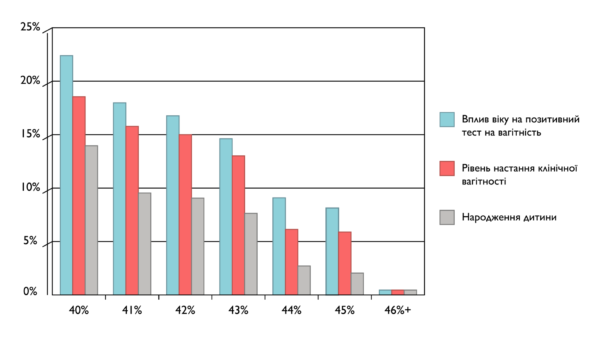
- The effect of age on a positive pregnancy test, the rate of clinical pregnancy and childbirth.
- Source: Reprinted from Klipstein et.al, with permission from Elsevier
Gene expression studies show that late reproductive age (after 35) alters the presence and activity of genes involved in important processes of egg quality formation, including cell cycle regulation, spindle formation, organelle integrity, and gene regulation, with potential effects on embryo formation. after fertilization.
With age in the processes of egg maturation:
● metabolism deteriorates
● dysfunction of organelles occurs, especially mitochondria (“energy stations” of the cell)
● the energy supply of the process of cell division decreases
● oxidative stress damages the nucleus, which contains DNA (this indicator is highly dependent on lifestyle and increases with smoking even in the past, excess weight, alcohol abuse and improper nutrition, constant contact with toxic substances)
● the strength of molecular bonds in chromosomes (structures that transmit genetic material to the future embryo from the egg cell) is lost
● there is a dysfunction of the control point of assembly of the division spindle
● meiosis errors and depletion of telomeres (important for the correct division of cells in our body and in the future child) occur more often
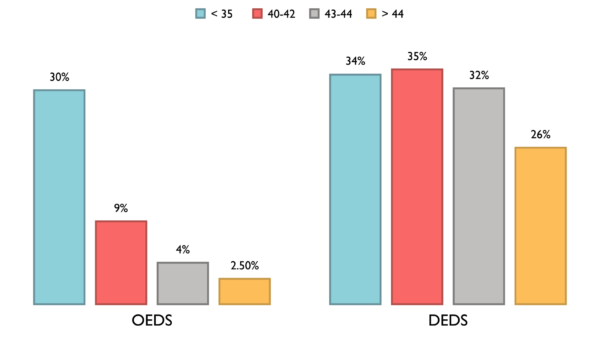
- Pregnancy rate per embryo transfer by age in Great Britain (OEDS own egg donor sperm; DEDS donor eff donor sperm)
- Source: HFEA, 2017
These processes gradually reduce the quality of oocytes.
Late reproductive age of the mother is the most frequent risk factor for chromosomal abnormalities, risk of spontaneous abortion, and the age-related risk of miscarriage is 51% at the age of 40–44 years and 93% after 45 years.
At the University of the United States, a survey was conducted among students (whose average age was 20.4 years). Students were asked whether they plan to have children. 88% of women and 90% of men answered that they plan to have children. Then the students were asked how they think at what age female fertility declines? 36% of women and 29% of men said from the age of 40-44 years; another 31% of women and 52% of men said that from the age of 45-60 years. (Fertility awareness and parenting attitudes among American male and female undergraduate university students. Human Reproduction (Oxford, England).
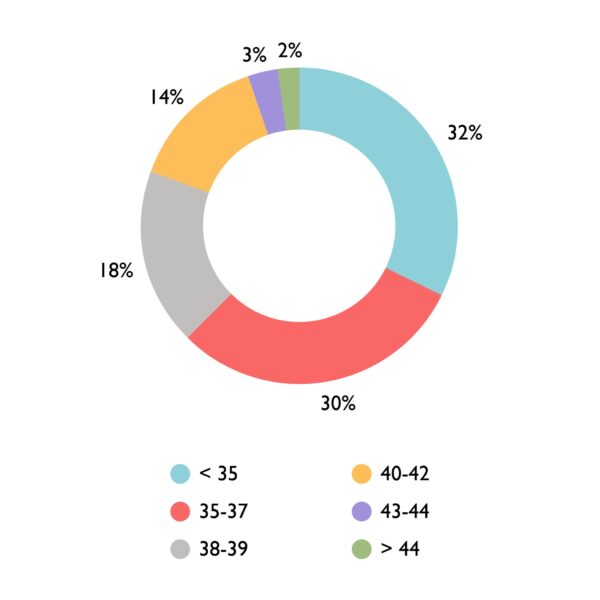
- Egg freezing by age in the UK
- Source: HFEA, 2018
The awareness of the global population about fertility is increasing, an example of this is the analysis of 973 women, of which 83% of people have heard about the “Delayed Motherhood” program, so it is expected that in the future women will undergo it at an earlier age for the highest effectiveness of giving birth to a healthy child in the future.